Should Your Med Spa Offer GLP-1 Weight Loss? A 2027 Decision Framework


Why GLP-1 is reshaping med spa revenue in 2027
In 2024, GLP-1 medications generated an estimated $1.3 billion in sales at aesthetic practices. By 2026, practices offering GLP-1 treatments were earning roughly 15% of their monthly revenue from the category. The patient profile is different too: roughly four in ten weight loss patients at these practices are new to aesthetics entirely, which turns GLP-1 into an acquisition channel for the rest of the menu rather than a standalone line.
The category is not a quiet add-on. Medical Spa Show 2026 flagged compounded GLP-1 oversight, peptide regulation, and state-by-state scope enforcement as some of the loudest topics on the floor. Owners are asking harder questions than they were a year ago, which is exactly the right instinct. This is a clinical service with recurring revenue economics attached — the upside is real, and so is the operational load.
The 5-question gate before you launch
Before you sign for product or build a landing page, answer these five questions in writing.

1. Who prescribes and supervises in your state?
GLP-1s are prescription medications. In most US states that means an MD, DO, NP, or PA on staff or under a documented medical director agreement. An RN cannot prescribe. An aesthetician cannot administer. The specifics of who can inject under which supervision model vary state to state — California, Florida, Texas, New York, and Illinois all have different rules on NP independence and medical director oversight.
If you do not have a prescriber in-house, your medical director agreement needs to cover GLP-1 scope explicitly, with documented chart review cadence. A vague "general supervision" clause will not hold up under board review.
2. How do you source product after the shortage?
The FDA resolved the semaglutide and tirzepatide shortages in 2025, which ended most compounded supply channels under 503A and 503B exemptions. Branded product (Wegovy, Zepbound, Ozempic, Mounjaro) is the compliant route for most practices today. Some compounded sources remain legal under specific clinical justification, but the default is now branded.
That changes the economics. Branded cost structure is higher per patient per month, which means your pricing model has to pass through. Owners trying to maintain 2024 compounded pricing in 2027 are quietly eating margin.
3. How do you price and bill?
Three pricing models dominate. Cash pay per vial or per month, with the program fee bundled in. Monthly program subscription with product cost plus a program fee (the most common). A tiered membership that bundles clinical visits, labs, and ongoing dosing.
Patients spending $500 to $2,000 per month on aesthetics tend to spend $350 to $600 per month on a supervised GLP-1 protocol. That is recurring revenue economics in a category that historically ran one-off transactions. If your current EMR and billing stack cannot handle a monthly recurring protocol with linked labs and consent, that is a tooling fix to solve before you launch, not after.
4. How do you manage adverse events and follow-up?
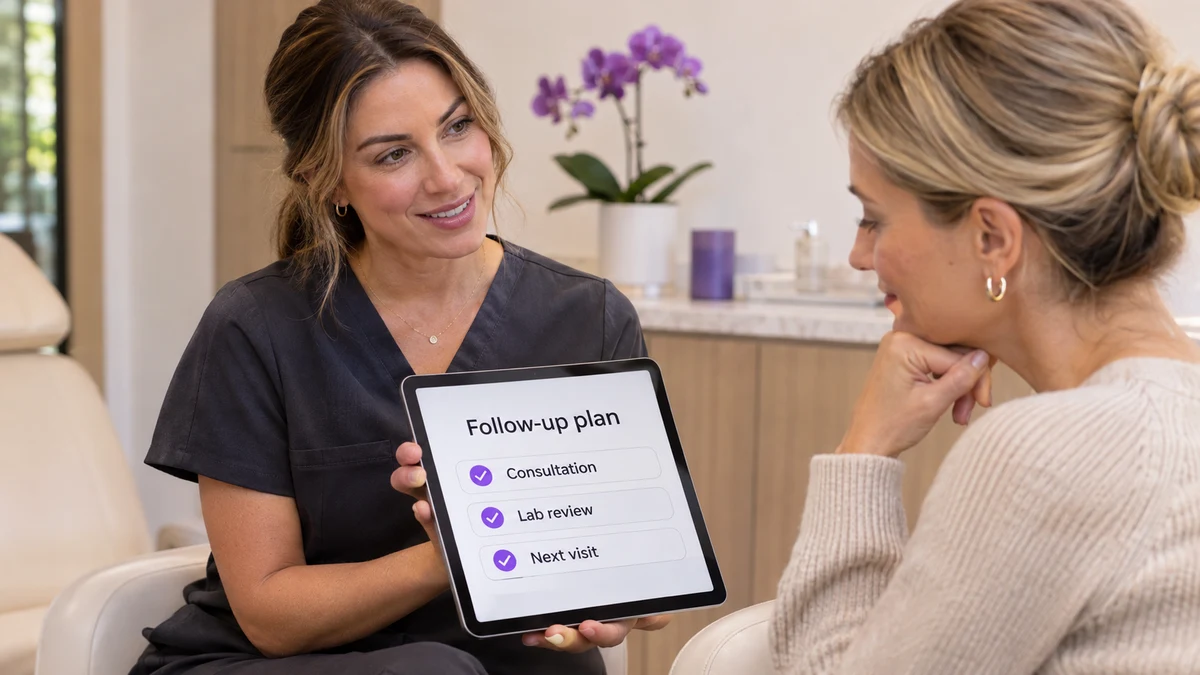
GLP-1s have a well-documented side effect profile: nausea, constipation, pancreatitis risk, muscle loss, gallbladder events, and the cosmetic sequelae of rapid weight loss. A protocol that does not include scheduled follow-up (at minimum: baseline labs, 4-week check, 12-week progress, dose titration cadence) is an operational and legal liability.
Build the follow-up sequence into your scheduling workflow before the first patient enrolls. Automated reminders, escalation rules for reported symptoms, and documented chart review by the prescriber each cycle.
5. How do you cross-sell aesthetic services?
The crossover is where the business case holds together. Patients losing 15 to 25 percent of body weight on a GLP-1 protocol develop facial volume deflation ("Ozempic face"), skin laxity on the face and body, and accelerated soft-tissue descent. The AAFPRS 2025 member survey reported 67% of surgeons saw a jump in patients seeking treatment related to rapid weight loss. One in four surgeons expects GLP-1 medications to drive greater demand for non-surgical aesthetic procedures specifically.
Map the clinical crossover now:
- Facial volume deflation → filler, biostimulators, fat transfer
- Jawline and neck laxity → Morpheus8, Ultherapy, AccuTite
- Body laxity and loose skin → BodyTite, Morpheus8 Body, RF microneedling
- Muscle loss → EMSculpt, EMFACE
- Skin quality → PRP, microneedling, resurfacing
Patients on a monthly GLP-1 protocol are in your clinic 12 times a year. Each visit is a consult opportunity for one of the services above.
What it costs to launch
A realistic launch budget for a single-location med spa adding GLP-1 covers medical director scope expansion or hire, initial lab panel contracts, consent and protocol documentation (templates can be licensed from AmSpa or drafted with counsel), scale and body composition equipment if not already in-clinic, EMR configuration for recurring protocols, staff training, and marketing creative. Most practices land in the $15,000 to $40,000 range to launch, excluding product inventory.
Marketing GLP-1 without tripping Meta's health-wellness classifier
Meta classifies weight loss creative under its health and wellness vertical, which means personal-attribute ad policy and before-and-after restrictions apply. You cannot imply a specific weight loss outcome, you cannot show before-and-after unless you work the aggregation and disclosure rules carefully, and you cannot use Meta's standard conversion events for lead optimization without flagging the health classification correctly.
What works in 2027:
- Lead-generation campaigns for free consultations, not for the medication itself
- Educational creative that frames weight management as a supervised medical program
- Google Ads search campaigns with branded landing pages — Google's medical advertiser policy is tighter than Meta's but more workable once approved
- Email to the existing aesthetic patient list — the single highest-converting channel for GLP-1 launches, because these patients already trust the brand
How BoomerangFX RUN handles the whole flow
BoomerangFX RUN runs the full protocol as one workflow: patient intake and consent, lab integration, recurring billing on the monthly program fee, chart review scheduling for the prescriber, automated patient follow-up and symptom reporting, and the aesthetic consult booking that turns a weight loss patient into a face-and-body patient. The EMR, billing, and marketing automation sit in one system, which is what GLP-1 at scale actually requires.
Frequently asked questions
Is it legal for a med spa to prescribe semaglutide?
Yes, when the prescription is written by a licensed prescriber (MD, DO, NP, or PA) operating within their state scope. The specifics of supervision and medical director agreements vary by state. Most med spas offering GLP-1 operate under a medical director arrangement with documented chart review.
How much does it cost to add GLP-1 to a med spa?
Most single-location practices spend $15,000 to $40,000 to launch, excluding product inventory. That covers medical director scope, lab contracts, consent documentation, EMR setup, staff training, and initial marketing.
How much do med spas charge per month for GLP-1?
Typical patient program fees land between $350 and $600 per month including product and clinical oversight, with some premium programs charging $800 or more. Pricing varies by market, product type, and whether labs are included.
Can an RN prescribe GLP-1 at a med spa?
No. RNs cannot prescribe. They can administer under a prescriber's order and standing protocol. The prescription itself must come from an MD, DO, NP, or PA.
What is the ROI of adding weight loss to a med spa?
Industry data shows practices offering GLP-1 treatments see roughly a 9% revenue lift versus a 2% decline at aesthetics-only competitors in the same market. Weight loss patients also spend an estimated 40% higher share as new-to-aesthetics patients, so the program functions as an acquisition channel for the rest of the menu.


