What Tools Do You Need to Open a New Med Spa in 2027?


Key Takeaways
- Your new clinic needs five tool categories: clinical devices, treatment-room infrastructure, compliance and safety, business operations software, and marketing tech.
- Pick your software before you pick your equipment. It dictates every workflow you’ll run on for years.
- Clinics that respond to a new lead within 5 minutes book 21x more consultations than clinics that respond after 30 minutes (ScaleHaven, 2026). Speed-to-lead is a tool problem, not a staffing problem.
You’re opening a med spa. The shopping list feels endless, and every vendor is pitching you their platform as the one you can’t open without. Here’s the honest version.
Your clinic runs on five categories of tools. Build them in this order and you’ll open with the budget intact and the schedule filling.
1. Clinical Devices
Your treatment menu dictates your equipment, not the other way around. Expect to spend $60,000 to $250,000 on hardware for a lean-to-mid build, and $350,000+ if you’re launching a full-service clinic with multiple device platforms (Vagaro, 2026).
What you actually need day one depends on your menu, but most new clinics anchor around:
- Laser hair removal system
- IPL / photofacial platform
- RF microneedling device (Morpheus8, Vivace)
- HydraFacial or equivalent, great for memberships
- Microdermabrasion and dermaplaning tools
- Autoclave and sterilization setup
- Medical-grade refrigeration for injectables
Buy platform-expandable devices where you can. Single-purpose lasers lock you into one service line.
For injectables: Botox, Dysport, Xeomin, or DAXXIFY, plus the filler lines your injectors are trained on (Juvederm, Restylane, RHA, Revanesse), PRP tubes and centrifuge, topical anesthetics, and hyaluronidase on hand for reversals.
Rule of thumb: injectables generate your day-one cash flow. Energy-based devices build long-term differentiation. If capital is tight, lead with injectables and add devices in year two.
2. Treatment Room and Clinic Infrastructure
The category that gets glossed over, and the one patients notice on every visit:
- Adjustable treatment beds and procedure stools
- Rolling supply carts and task lighting
- Facial steamers and UV sanitizers
- Point-of-sale hardware (iPad, card reader, receipt printer)
- Waiting-room furniture, retail displays, branded signage
- Front-desk workstation with printer, scanner, and label printer
Don’t under-spend here. Patients remember a chipped side table in the treatment room longer than they remember the result.
3. Compliance and Safety
Your clinic is a medical facility. These are non-negotiable:
- HIPAA-compliant digital intake and consent forms
- Encrypted PHI storage with Business Associate Agreements from every vendor
- OSHA exposure control plan, MSDS, incident log
- Laser safety eyewear rated by wavelength
- Emergency crash kit (epinephrine, oxygen, airway, AED)
- Biohazard and sharps disposal contracts
- Signed medical director agreement with standing orders for every procedure
- Credential files for every provider
- Malpractice, general liability, and cyber insurance
Thirty-six U.S. states have no specific med spa statute (Pabau, 2026), meaning compliance rests on your state’s medical practice act and board guidance. The clinics that document this digitally, inside their EMR, are the ones that pass audits cleanly.
4. Business Operations Software: Your Operating System
This is where new owners most consistently make the wrong call. The instinct is to stitch together point tools: Calendly for booking, Square for payments, Mailchimp for email, a spreadsheet for everything else, “and we’ll figure out an EMR later.”
What you’ll actually get is double data entry, no reporting, broken patient journeys, and a full backend rebuild by month six.
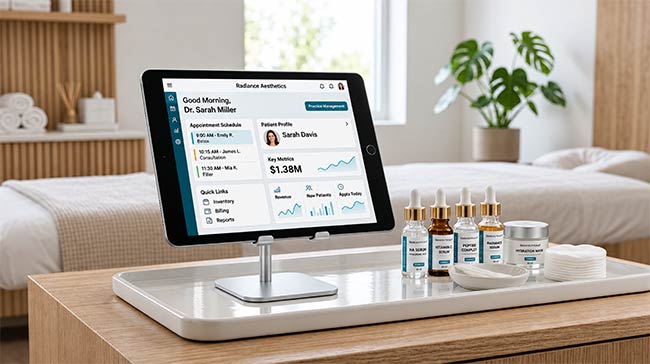
Pick an all-in-one practice management platform before you open and build every workflow around it. You need:
- EMR and clinical charting with photo management and digital consent
- Online booking and scheduling
- Patient CRM with two-way SMS and email
- Integrated payments and POS
- Inventory tracking (critical for injectable margins)
- Memberships and recurring billing
- Loyalty, packages, and gift cards
- Reporting dashboards you can actually act on
BoomerangFX combines all of this into one HIPAA-compliant platform built specifically for medical aesthetics. For a new clinic, that’s the difference between running seven vendor dashboards and running your entire practice from one screen.
5. Marketing and Patient Acquisition Tech
If you don’t have your marketing stack live before you open, you’ll open empty. The clinics that walk into month one with a waitlist have been running pre-opening marketing for 90 days.
What you need in place:
- Website with HIPAA-safe forms and treatment pages targeting local search
- Google Business Profile, claim it the day you sign your lease
- Meta Ads account with Business Manager, Pixel, and Conversions API wired to your CRM
- Google Ads account targeting buyer-intent queries like “botox [your city]”
- Landing-page builder for offer-specific pages
- CRM with lead capture and sub-5-minute response automation
- Email and SMS automation for waitlist nurture, welcome, rebooking, and reviews
- Review management across Google, Yelp, and RealSelf
- Call tracking for paid-channel attribution
Budget expectation: most established clinics spend 8 to 14% of revenue on marketing. For your first six months, plan on $5,000 to $15,000 per month to seed demand before you open.

Build Order That Works
- Lock legal, licensing, and medical director agreements
- Pick your practice management software. It dictates every workflow.
- Finalize your treatment menu, then buy only the equipment that serves year one
- Build out the space and compliance infrastructure
- Launch website, Google Business Profile, and ad accounts 90 days before opening
- Open a waitlist with a founding-member offer; soft-launch with 20 to 30 patients before the full grand opening
Three Mistakes That Blow the Budget
- Buying three laser platforms in year one. One is almost always enough.
- Choosing software on price, not fit. A $50/month booking tool costs more in operational drag than an $800/month medical aesthetics platform ever saves.
- Treating marketing as something you’ll figure out after opening. Marketing starts the day you sign the lease.
FAQ
What’s the single most important tool for a new med spa?
Your practice management software. It’s the system every other tool and process plugs into. Picking it last is the most expensive sequencing error new owners make.
Should I buy or lease my equipment?
Lease or finance major devices in year one. Locking $150,000 into a single laser before you have proven booking volume is high risk. Buy outright once demand is validated.
Can I open without laser equipment?
Yes. Many of the most profitable new clinics open as injector-focused suites with no energy-based devices. Injectables deliver strong day-one cash flow with a fraction of the capital outlay.
Build the Stack Once
The clinics that scale cleanly in years two and three are the ones that chose their software on day one and didn’t have to rip it out at 500 patients.
BoomerangFX is built specifically for medical aesthetics: practice management, patient engagement, and marketing automation in one HIPAA-compliant platform. If you’re planning your opening, book a demo and we’ll walk you through the stack other new clinics have used to open fully booked.


